October 25, 2011

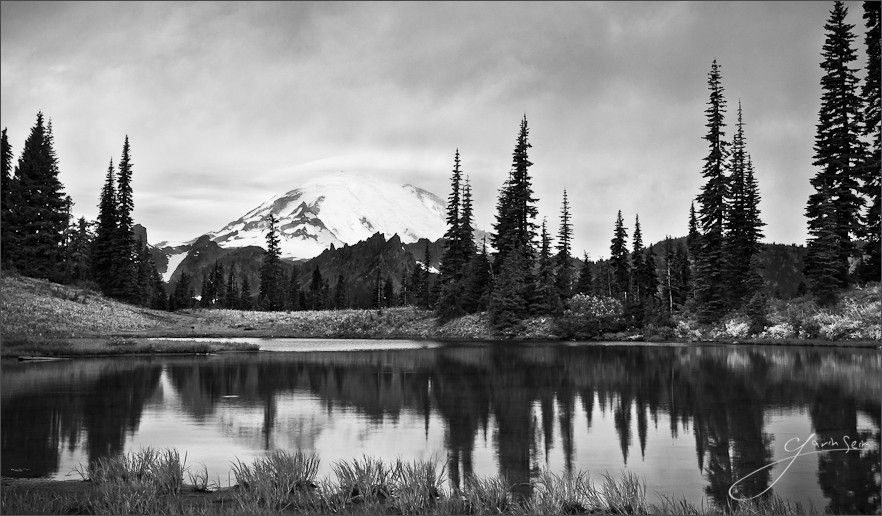
Song of a Dreary Day - Upper Tipsoo Lake, Mount Rainier National Park, Sept 2011, by Gavin Seim.

Mountains are something that never quite grow old. But they don’t always cooperate with my whims. Clouds and mists and empty skies,this was one of those days. Sort of.

We headed up the mountain around sunset. A group of photographers and I were out camping that weekend for an event I had organized. I was hoping for one of those radiant late summer sunsets, but not today. Oh, it’s beautiful and peaceful and all, but that does not mean the light was doing exactly what I wanted.

Still, even on the days that seem less than perfect, there is light. Light that has a subtle beauty all it’s own, especially if you catch it at the right time. Well, there was light on those peaks, and there were even dramatic clouds mixed in with that sky that at a glance appeared a bit boring. They kept peeking out as they blew past the peaks, and I waited for them. I think there was a song in that light after all.

Release details: Prints available. Contact the gallery. Learn more about prices. Available prints…


For photographers. How it was made…

Read More

October 24, 2011

And How it Can Change Your Life in 30 Minutes.

By Gavin Seim (updated 01/13) – This may be the most important piece I’ve written on photographics. Because no matter what you photograph, once you see in Zones, you’ll never see the same again. You’re on your way to truly mastering light.

I started photographic study when I was twelve. But in recent years I’ve started working with 4×5 large format film and digital side by side. I’ve explored endless exercises in tonal control, “truly” learned to visualize, and implemented the Zone System that was developed by Ansel Adams and Fred Archer, both in my film and my digital work, in color and black and white. Zones are the language of light and they’ve changed everything about how I see.

Master Zones & Exposure Dynamics – Get Gavin’s Workshop Series.

The idea of visualizing and using Zones is not promoted much today. It seems much of the industry arrived at digital and decided that the past 150 years of photographic knowledge were somewhat irrelevant. Maybe it’s that many never took the time to understand Zones to begin with. Which is a shame because it’s so brilliant. What I’m about to show you is not taught much, but understanding it WILL change your image making forever. I’m not kidding; once you grasp this, you’ll never see light the same again. You’ll probably want more after this, so check out the links at the bottom for further reading. Also you can get hands on in my annual 3 day Lights & Shadows workshop. And check out my video series, EXposed which gets deep into Zones. OK lets dig in.

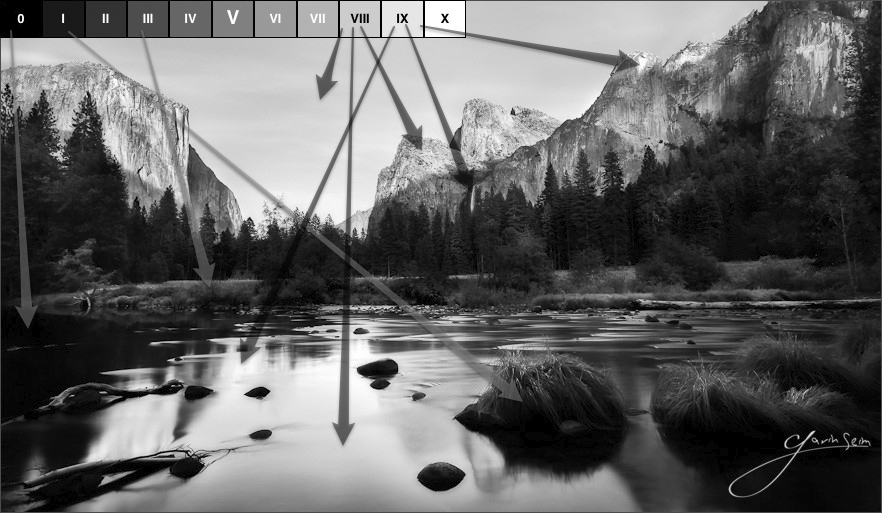
Sunsets Hidden Falls. Yosemite, 2010 – A general look at where I placed the scene elements in relation to the Zones. Each arrow leads to what I see as the zone on the scale.

I’m going to stay simple because these concepts are simple. I’ve not come up with a new digital based zone system, a stripped down version, or an article filled with nerdy equations, white papers, or complex charts. This is not hard and you can start putting it to use TODAY. Since most of us are in the digital world, I’ll focus on that. I’m going to show you how to use the core of the Zone System to make you a vastly better photographer. I’ve also brought along some examples for analyzing said Zones.

To those of you who already know this, kudos. But I challenge you to consider whether you’re really using it, or just buzzing along in digital bliss and fixing things later. Excuse my bluntness, but this is happening to the best of us. We need to get back to basics and visualize, control tone, dynamic range, image quality and presentation

The Zone System was a complete approach that included everything from the initial exposure to the final print. Now we don’t use darkrooms much these days, so I’ll focus on the pivot point of the Zone System: the Zones themselves. That said, I would encourage you to study the whole process even if you don’t use film. It will help you gain a better understanding of photographics. Not only that, but old books like Fred Picker’s Zone VI workshop deal with it quickly and effectively and can often be had for mere pennies.

1. The Zone Scale.

The Zone Scale lies at the core of the Zone System. It consists of eleven squares that span from clipped black (Zone 0) to clipped white (Zone X). Each square represents a change of one stop. The first part of using Zones starts before you release the shutter. Truly visualizing your image is like nothing else. Once you master it, you see the image you plan to make (including your edits and refinements) in your mind before you ever take the photo. It changes how you photograph and how refined the resulting images become.

Brilliantly simple, the Zone scale allows us to visualize all our light from complete black to complete white in clear one stop increments.

To begin with look at the Zone scale. Now look at your scene. Now back to me 😉 What’s outside your window right now? Visualize what Zones the things around you fall within. Then imagine you’re taking a photo. Imagine where the Zones “would” fall if the image came out exactly as you wanted. It does not have to be what you “see” but what you “visualize” for the finished image. How do YOU want to make it?

Think about how Zone levels on various objects in this scene would complement your primary subject as well as your supporting cast of elements. Sometimes it helps to begin by visualizing a scene in black and white even if your final image is going to be color. Thinking in terms of tones can be helpful, especially early in the process.

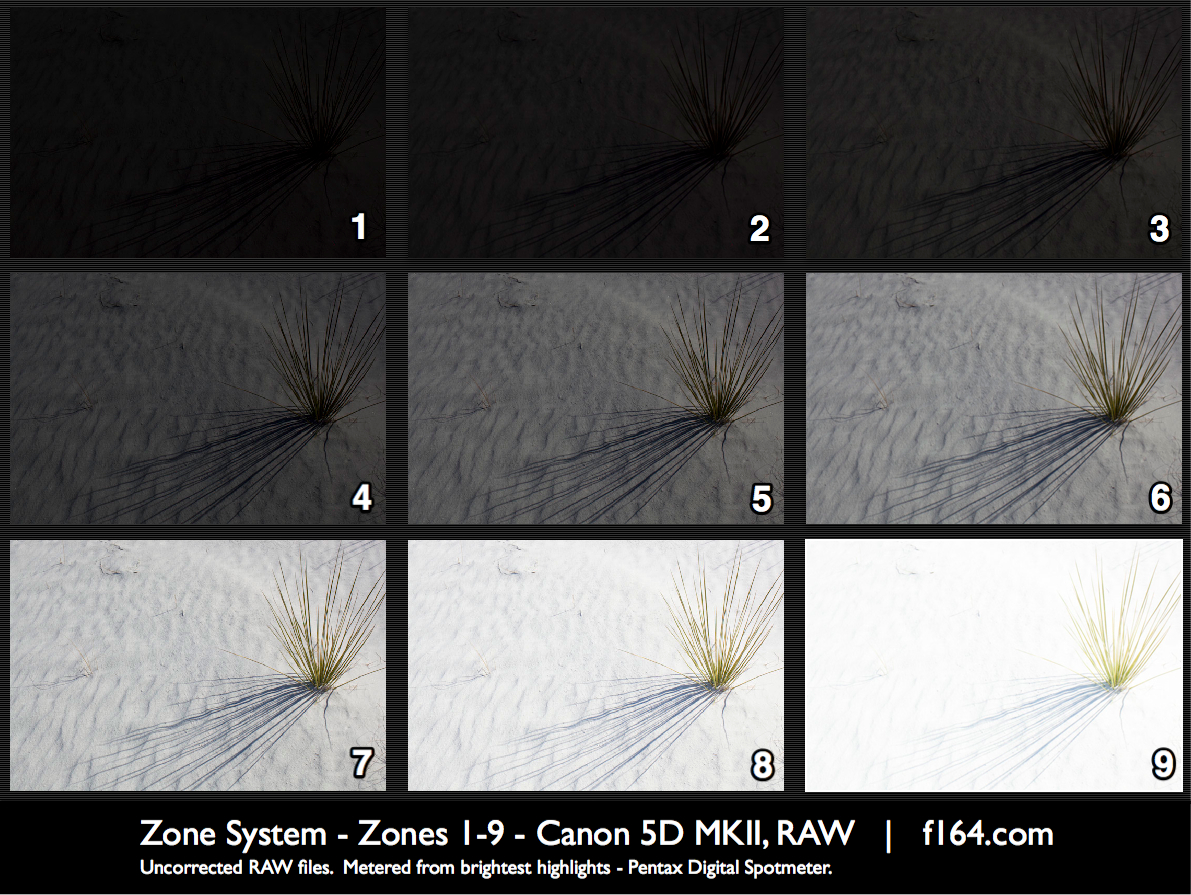
All nine detail Zones photographed with digital. Metering was based on the brightest area here, but we could have metered meter any element and uses the system to place that element in any of the time values but simply moving exposure up or down (click for larger view).
Read More

October 10, 2011

By Gavin Seim

Simplicity is key to a great photograph. It turns even complex scenes into stunning beauty by controlling elements, light, and tone.

It’s not about how much is in a photograph. It’s about how we showcase our subject in relation to that supporting cast of elements. Now I’m not suggesting the images I show are “perfect.” It’s rare that I get everything dead on, and I can always find something I should have done better. But truly understanding and mastering these elements WILL raise the bar on our images and allow us to see in a new way.

1. Visualize.
Everyone says they’re doing it, but few actually are. You should truly “see” the scene in your mind’s eye; not what’s in the viewfinder but the finished image after the exposure, even after editing. You should see the image you want after the process is finished. It’s fairly simple, but in the rush we often fail to slow down and think carefully about the lines, elements, and tones in our scene. That’s one reason why I love working with a tripod. It takes my focus away from holding a camera and puts it on the scene in front of me.

Ansel Adams said, “The whole key lies very specifically in seeing it in the mind’s eye which we call visualization.”

Sunsets Hidden Falls, Yosemite 2010, Gavin Seim - I used a layer based HDR process on this, processing my light and dark frames as silver and layer blending in Photoshop. I spent a good deal of time on the composition and tonal control to try and keep the scene simple while still showing all the elements. You can see the stone faces on Zones 6-7, with the foreground elements falling drastically all the way down to Zone 1, keeping them as supporting cast from becoming too distracting.


2. The Light & The Zones.

Expose for what you want in your image, not what the camera sees. This goes right along with visualization, and the Zone scale is the best way I know of, both to visualize and to control values. It allows us to see in our mind’s eye the Zones in a scene and place them where we want, using exposure, and finally tonal edits. For more on detailed tonal value control, see the counter article to this one, 3 Critical Elements of Controlling Tonal Values.

The Zone scale from 1-10. Middle grey is Zone V (5). This shows the darkest dark to the lightest light and is invaluable for simple visualizing and exposing a scene. Each step represents a stop, making it easy to move your exposure up or down and place an element in a given zone.


Read More

September 29, 2011

Gavin Seim: The folks at Nikon got a little too enthusiastic yesterday and posted this on their FB page, telling us that “A photographer is only as good as the equipment he uses” Perhaps they were momentarily blinded by how the world seems to actually look at photography these days and forgot that it’s actually a skill. Oh wait, I guess it was companies like them that promoted that idea 😉

Don’t get me wrong, quality optics and the like are important considerations. But the best gear is of no value at all, unless your good enough to make it sing. If I play a Stradivarius, it still sounds something akin to cats being run over by trucks.

I’m not sure what’s more scary. That Nikon posted this. Or that 1695 people Like it. Thanks for sending us this Greg. We still love you Nikon (sorta), but really. Teach your social team about photography.

Read More

September 20, 2011

by Gavin Seim: Anyone can learn to use a camera to capture snapshots of time. That’s valuable for history and for precious memories. But it takes more to be a skilled photographer. Not just a picture taker, but a picture maker.

It takes tireless study, practice and long experience. I contend it’s no easier than being a sculptor or a doctor. A lawyer, or a painter. It requires being a skilled technician, a craftsman and a creative director. It’s neither fast or easy. But it’s one of the most rewarding skills one can study and master.

But that’s just my opinion. So I’ve scoured websites, videos, books and even picked up the phone for thoughts about photography from many of the renowned masters of it’s history. Thoughts that seem resound it’s ever alluring call. Reminding us to return to the basics of what makes a great photograph and perhaps to remember, that digital is just a baby next to more than a hundred fifty years of photographic history… Gav

_____________

  • “The whole key lies very specifically in seeing it in the minds eye which we call visualization” – Ansel Adams
  • “If continually people look and look and always come away enriched, then it’s a great work” – Sister Wendy.
  • “If I have any ‘message’ worth giving to a beginner it is that there are no short cuts in photography.” – Edward Weston
  • “The sheer ease with which we can produce a superficial image often leads to creative disaster.” – Ansel Adams
  • “Tone” may be the least understood, and least utilized factor in composing and finishing images” –  Ken Whitmire
  • “A portrait is not made in the camera but on either side of it.” – Edward Steichen
  • “You don’t take a photograph, you make it.” – Ansel Adams
  • “It’s one thing to make a picture of what a person looks like, it’s another thing to make a portrait of who they are.” – Paul Caponigro
  • “Becoming a professional artist takes talent and perseverance, even more so when the field is photography.” – Clyde Butcher
  • “Never put lettering in your photos unless you want it read.” – Jay Meisel
  • “Sometimes I do get to places just when God’s ready to have somebody click the shutter.” – Ansel Adams
  • “In photography there are no shadows that cannot be illuminated.” – August Sander
  • “If you have enough craft, you’ve done your homework and you’re practiced. You can then make the photograph you desire.” – Ansel Adams
  • “No place is boring, if you’ve had a good night’s sleep and have a pocket full of unexposed film. – Robert Adams
  • “A photograph is usually looked at – seldom looked into.” – Ansel Adams
  • “Saturate yourself with your subject and the camera will all but take you by the hand.” – Margaret Bourke-White
  • “We have glorified the camera itself. Which is only a tool.” Ken Whitmire
  • “Photography is the power of observation, not the application of technology.” – Ken Rockwell
  • “There are two people in every photograph: the photographer and the viewer.” – Ansel Adams
  • “A sloppy performance in a photograph is as distressing as a sloppy performance in music.” – Fred Picker
  • “Be aware of every square millimeter of your frame.” – Jay Meisel
  • “We are basically directors of images. Our objective is to attract the eye and leave an impression the mind.” – Ken Whitmire
  • “There is nothing worse than a brilliant image of a fuzzy concept.” – Ansel Adams
  • “No photographer is as good as the simplest camera. – Edward Steichen
  • “A better camera won’t do a thing for you if you don’t have anything in your head or in your heart.” – Arnold Newman

Read More