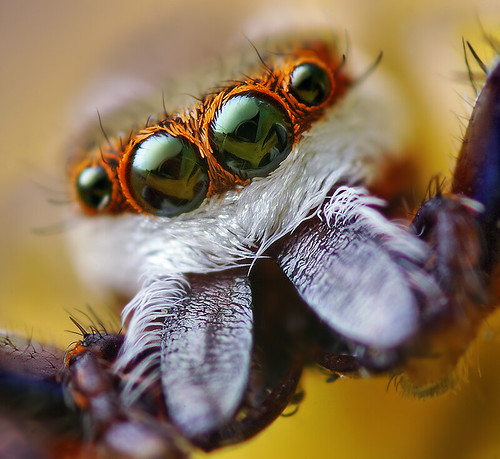
Over the past couple months, I have been keeping an eye on the photostream of Opo Terser. Armed with a Pentax K200D, Opo’s various photos show a fine mastery of macrophotography [which is fairly tricky when working with insects].  Coming from a fellow entomology enthusiast, it is really stunning to see the amount of insect ‘head shots’ in his photos.
Getting fully focused, color rich photos of insects takes several attempts, considering how fast most insects move in comparison to a camera shutter. Opo is also an avid astrophotrographer. What is most interesting about both his astro and macro photos would be that they are both taken with the same Pentax K200D camera.
A good majority of astrophotographers I know or have studied use an entirely seperate camera to capture images. Furthermore, it is pretty rare to find someone willing to photograph far off galaxies as well as rare insects. Enjoy and be inspired!
Although CNET may have been a bit too swift in posting video for the camera a couple days ago [prior to Canon’s announcement], it looks like quite the frenzy of news is centered around Canon’s Rebel T1I ability to capture video. I always find it funny when info is ‘accidentally’ leaked in the tech world only for the victim [in this case Canon] to give off the impression as if they are forced to release this information. Be that as it may, Canon has a new ‘semi-entry level’ DSLR. Here are the specs:
15.1 megapixel CMOS sensor
HD video capture (1080p at 20fps; 720p at 30fps
DIGIC 4 processor
3? LCD w/ 920k dot resolution
3.4 frames per second
ISO 100 to 12800 sensitivity range [although if you look at the CNET video, it appears to only go up to 3200? They could still be tweaking the T1I’s OS]
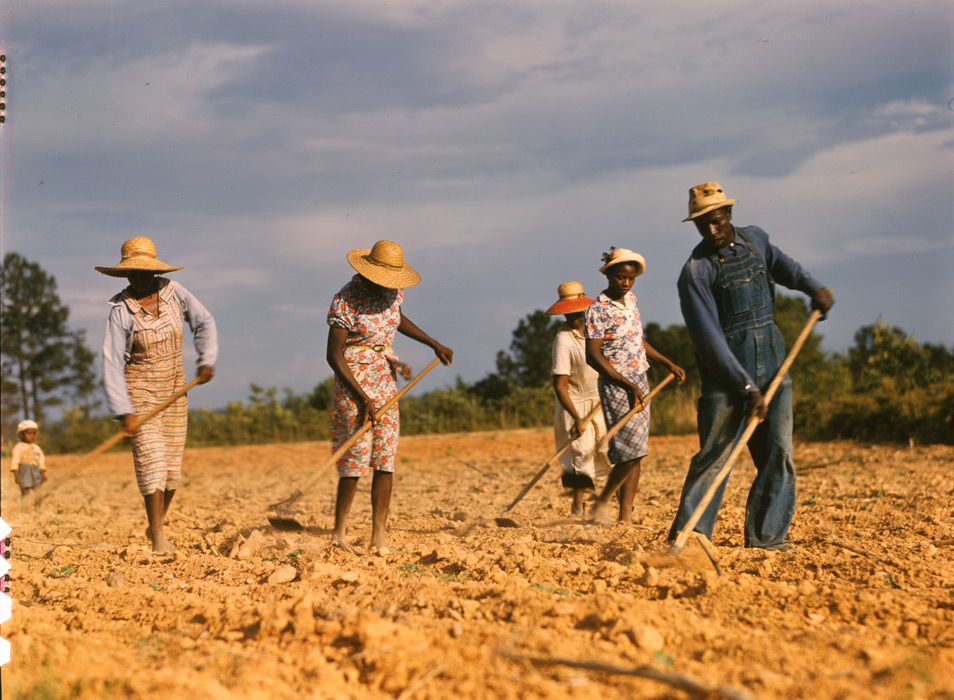
Above is one of many photos which was recently released by the Library of Congress, Prints and Photographs Division.  Looking at the photos from the FSA-OWI era, this one in particular, one can not help but think of the power of documentary photography. What is striking with these newly released photographs would be the power of color photography in contrast with the already established power of the now, iconic, black and white photos of the FSA series.
We can see that Robert Lee, Jack Delano and the rest of the FSA legends are masters of their crafts; even moreso with the addition of their color photography.
What I find most interesting in this most recent set of photos would be that we as artist or art enthusiast have known of the FSA series to be one of the foundations of what makes black and white portraiture evocative. How a shared moment in time could be could completely trump a ‘staged’ studio portrait. It also goes without saying how strange of a time we live in now, where seeing these photos on a ‘relatible’ level. If you are American or a citizen of the world and just so happen to be from a meager background, these photos show a rich reflection of how we once were. These photos show us [be it positive or negative] what we are today.
This week we talk about some great new gear and goodies, as well as hear cool tips from some great guests including the one and only David Ziser. Here’s all the glorious links and there’s a lot of them.
Images stuffed into mat pages, then an album covers is becoming less and less attractive to clients. If you’re designing wedding, event, or portrait albums you’ve probably played with making layouts in Photoshop or another program to then have printed as flush mount albums like Kiss or Asa Books, You might have also used press books like the ones from WHCC. Once you have a good design there’s loads of choices, but it’s the design that’s the challenge.
As many people know the service and support of Adobe has gone in the toilet in recent times and while they need some competition to slap them back on track, their software is still great. Today I want to talk about In Design CS4 and how it relates to album deisgn. I’ve tried various tools for album design, some of which worked really well. When it comes to crunch time however, I’m finding In Design is the king.
I learned the basics about using ID for albums from a video that Kevin Swan made. And now gives free on the Kiss books site. Not required but it was sure a great crash course and I use it often to hone up my knowledge. The bottom line is that it’s fast, easy and powerful. Once you get the hang of it.
In Design was not actually designed for photographers to make albums. Rather it’s the industry standard for designers doing layouts on magazines and other published material. It turns out however that it works a treat for doing albums. Bear in mind it’s not a photo editor. What ID rocks at, is laying out pages and doing it fast.
I cringe when I think of doing individual pages in Photoshop. It’s not a page design tool and it’s tedious to do layouts with. What I love about ID is that the entire project is contained in a single file. All images on the pages are referenced to the original files on your computer similar to when one makes a web page. You can edit and change you design in one place and when it’s finished just export the final file as a PDF of JPEG’s. Kinda like the way we use Lightroom.