Endless lines with dappled light and colors, even after sunset. I think there’s a lot to learn about photography from the ocean: the patterns and lines, the way it plays the light. Never have I seen so many perfect lines as in the waves and currents. Now excuse the quality of this video as I was using only my iPhone, and it was nearly dark, but crank it up to HD, and I hope you’ll get a little of what I felt here.
This is from our Spring tour while in Pismo. I did take home some photos of the ocean that you may have seen in the archives, but the other thing I took home was awe. Maybe I just sound crazy, but my excitement was genuine. I came away with stronger concepts of line and tone. I’ve always loved water, but this challenges me to look at it even closer; to see beauty even in the smallest details of surf and learn something about light from its ever changing surface.
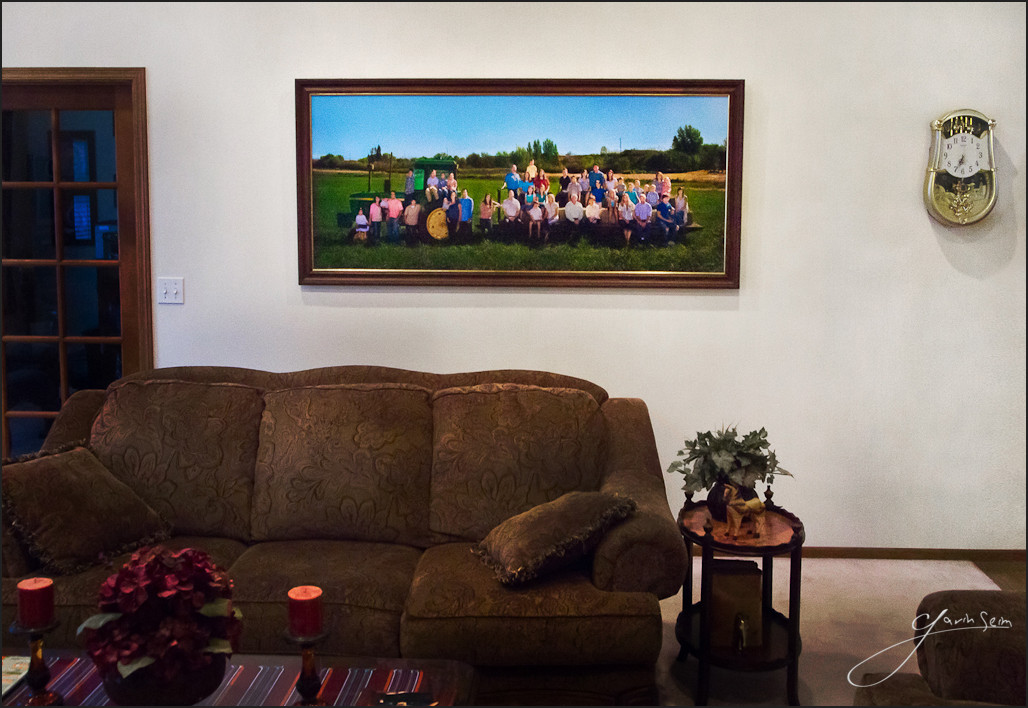
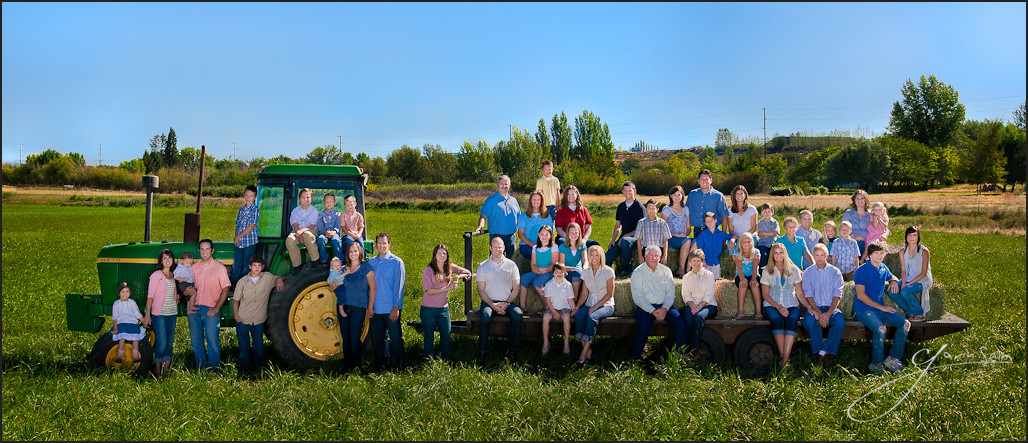
The Chamberlains. Commissioned portrait, Summer 2010. Final 70" classical framed canvas hanging in client's home.
This journal consists largely of my fine art, but I don’t restrict my work to pictorials. Classical art is often composed of commissioned portraits, and the pieces are no less because of it. So when I make a portrait, I make it for my client’s needs, but creatively, I want something stunning enough that it could hang in museum ten decades from now.
We planned the Chamberlain portrait for weeks. I was determined to avoid the stereotypical toy solder line of people that is so common, especially in very large groups. We planned this to be a wall piece, and we succeeded. It now hangs as a handcrafted, seventy-inch canvas in the client’s living room, and, I confess, I’m very proud of it, though it’s not done justice on this tiny screen. I wish you could come to the studio and look at the one on my wall.
This image set a new standard for me in proving to myself that a group portrait need not be a stereotypical clustering of people with grim faces and awkward poses. It also won best photo at the Winter Fest art competition, which was really cool. I’m thankful that I was able to capture this family in way that shows three generations, tells a story, and hangs beautifully on the wall. In planning this, I opened up a world of new ideas for the way I conceptualize commissioned pieces.
On this shorter episode Gavin takes a look at what he learned with another month on the road. A discussion of 4×5 film, a look at learning and working conceptually, and a little practice session on evil laughs.
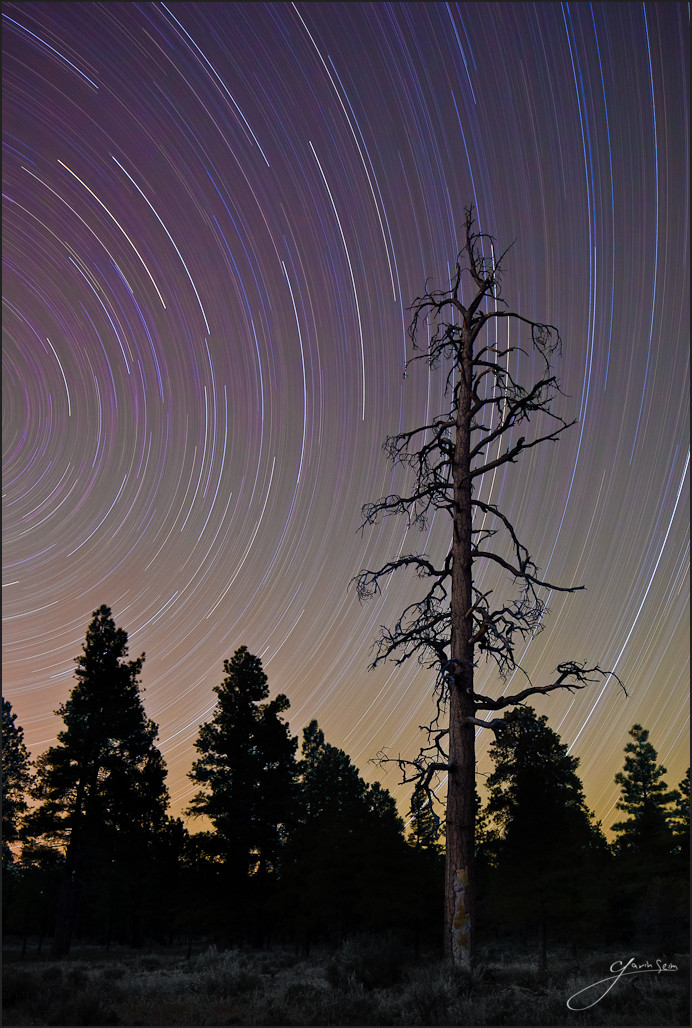
140 minutes of night. Gavin's longest ever exposure. Click the image to see Gavin's post with all the details.
It’s time to Raise the Bar. There’s not a lot of “photographers”. There’s just loads of people with Facebook pages who charge for snapshots.
Webster says a Photographer is…
One who practices photography; especially: one who makes a business of taking photographs.
Webster also says that Practice is…
2a : to perform or work at repeatedly so as to become proficient <practice the act>.
Webster says that proficient is…
Well advanced in an art, occupation, or branch of knowledge.
by Gavin Seim: This is not another one of those posts about when you become a pro. Nor is it a post to be mean. The opposite in fact, so read it through if you want the whole concept. I pose this question to get us thinking. Are you really a photographer?
If you want to be an Athlete you train tirelessly. If you want to be a doctor you have to study and then study even more. If you want to be an airline pilot, it takes years. If you want to be a “photographer” it takes all those things as well. Though many seem to ignore that part.
Sometimes I avoid calling myself a photographer these days because the word is so abused. In a few years I think consumers will really start to notice. The digital high will settle and they’ll realize they’re being shammed. Like a doctor, who you find out knows nothing about healing.
I know, we could say “I’m practicing to become proficient” and that makes me a photographer. OK, but that’s not really how it works out there. In other skills, it’s pretty much assumed you’re skilled if you say you’re a…. doctor, lawyer, mechanic, carpenter, baseball player, etc.
In the real world, “practicing to be proficient” also means you’re training. And that doesn’t mean making up your own rules and calling it your style. It means continually exercising your skill to become even more skilled. You don’t just become something because you bought the gear, and you don’t stay proficient without continued practice of your craft.
Now titles don’t make the man (or woman) and there are certainly different skill levels. But I submit that unless you’re reasonably advanced in the art and craft of making photographs, you’re not yet a Photographer. You’re just a snapshooter who’s aspiring. That’s OK, and maybe you even get paid for it at times. But be honest. Be who you are and you’ll learn much faster than faking your way along.
What am I getting at? Chiefly this. The word photographer has been deluded. It seems everybody and his brother (and probably his mother too) gets a camera, makes a crappy website, gets a Facebook page, then calls themselves a photographer and charges people for the snapshots they make which require almost no skill. In so doing they to a disservice to themselves and the client.
I know my headline is a bit bold. I wanted to get your attention. Also my bluntness may offend some because I’m saying something many don’t want to hear. But let me be clear. I’m NOT saying because you’re new you should pack up and go home. But you should understand how much training it takes to be a photographer. The purpose of this post is to make people feel like losers. It’s to look at ourselves and be honest in our assessment. Because if you want to be taken seriously, you need to be a skilled craftsman.
If you hammer in a nail does that make you you “a builder”? If you remove a sliver with a pen knife are you “a surgeon”? If you get a camera are you “a photographer”? I say no. You are not yet a practitioner of the craft that is photography. That takes time. A lot of it, and the standard is higher than ever if you really want to stand out. I even see long time pro’s who are not making the grade. They’re not “practicing” their craft. They’ve become slack, thinking they’re “good enough”.
I’m twenty six and I don’t mean to sound grumpy or bitter. I’m not. I started from nothing and I enjoy helping aspiring photographers. But it seems everyone wants the easy road. No one wants to spend the years of effort it takes to become a craftsman. Maybe I was the same way starting out. But it didn’t work. People think that because they bought a camera and tripped over a few good scenes they’re an artist. Which is why they’re not.
Everyone is making snapshots and even a few good photos. That’s fine, but it’s not rare, it’s not unique and it’s not valued much by society. Millions are made every day and billions will be lost to history as nothing more than trash. You’re friends on Facebook may be supportive and say how great and talented you are. I know that feels good. But I ask again. Do you really know your craft? Are you images following a standard of quality that is far above the snapshooter.
Now if you want to make a living, the business side is a whole different discussion. Photography may be one of the hardest professions to make it in these days and that’s when we come to marketing centric workshops and events like the Wall Portrait Conference. Discussion for another day, but if a paycheck is your goal, along with all this learning you should also be studying business. Become a master at both and you’ll really have something. And if you just want to make photos because you love photography. That’s OK too.
Being a Photographer?
You have to spend years. It’s taken me fourteen & I think I’m a photographer, but I still have a lot to learn.
Go learn. Yes it will cost you real money. Be it a school or weekend workshops. Do it.
Perfection is needed. Because good is everywhere. You need to be better than good.
A photographer is trained. Just like a baseball player, a doctor, a rocket scientist.
The bar has been raised. Now that everyone takes photos, you have to be a master.
So, if after all this you can say you’re a trained expert. If you’re work stands above to the masses and shines. If you understand the mechanics as well as the art of making a great photograph. And if you can prove it. Then I say you are a photographer. If you can’t, then be honest and say you’re aspiring or an apprentice. That’s OK for now. In fact you’ll probably feel a lot better being honest with yourself and you’ll learn faster.
Not to all of us of all skill levels. Get out there and practice. Lets keep learning and raise the bar on quality. Good luck… Gavin.
Today I’ll share all my best tips for star trail photography.
I remember when I was starting in Photography, I had a book from the film days called DayBreak 2000. One of the photographers took an ultra-long exposure of the stars as the new millennium entered.
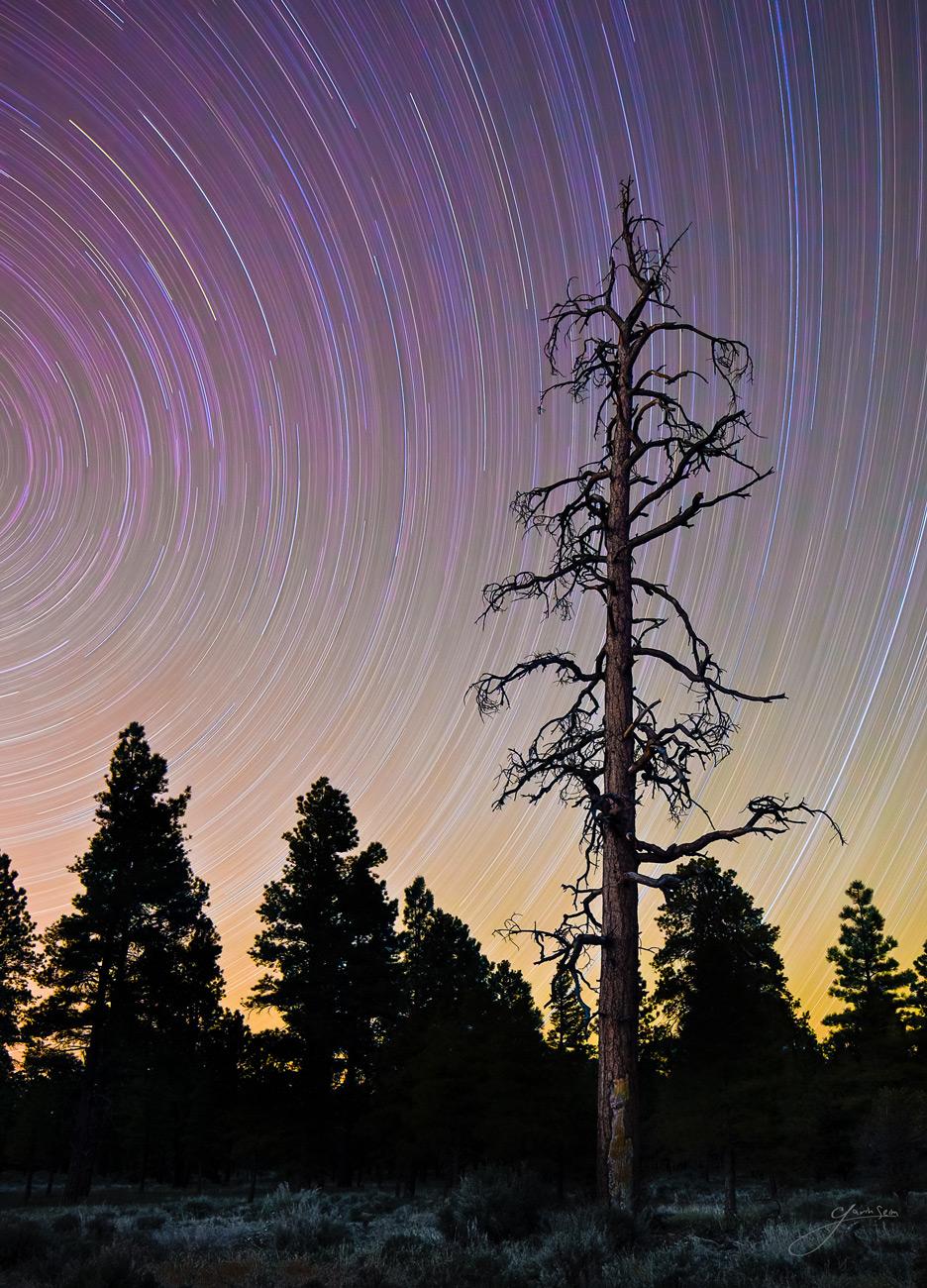
A decade later, I saw an old tree in the forest outskirts of the Grand Canyon, dwarfed by the vast sky. My mind came back to that photo I saw as a teenage photographer with a 35mm camera.
At 2 hours and 20 minutes, this is my longest exposure. We were in the hills near Grand Canyon NP, an area known for its views of the night sky. We set up camp in the open woods about a hundred yards from this tree and I had been eyeing it for a couple of days.
How it was made and how to photograph stars.
I used Canon 5D MK2, 24mm TS-e II, f8, ISO100, exposure 140 min main exposure.
The 5D2 was a great camera. But in 2011 sensors were not as good, and high ISO or long exposures, and the sensor heated up after about 5 minutes and produced artifacts. Some of these steps would be easier on today’s modern sensors.
Setting up before was key here. This was not a quick shoot and go project. There’s no redo if I fail. I have this rather bad video of the setup, so you can see the content here and why I did what I was about to share with you about how to photograph stars.
I spent over an hour walking around the tree and testing angles, focus, and composition. I also tried various shift settings with my 24mm tilt shift lens to control perspective until I found the one that I felt the most natural, shifting just a bit up to reduce the distortion of the tree.
Setting up for star trail photography.
Some might say there’s no way I could spend so long and still be improving it, but that’s wrong. Taking the time on this was, in my opinion, one of the most important factors in this image. Thinking an image thru always makes a difference.
This is not street photography or a wedding. In mastering night landscapes, I learned that pre-planning and setup is perhaps our most valuable tool. More on that below.
“Pre-planning and shot is perhaps our most valuable tool. “
When I finally decided on a spot, I kept tweaking and focusing, then going in the camper to analyze it on the laptop. My planning was purposeful because my exposure was so long and I had one shot. I would be shooting in the dark so I set up the camera exactly where it would be and left it until that time came. This paid off, giving me far more control than a last-minute night composition using the high ISO long exposure test technique.
A few hours later, the sun was gone, and true night had set in. I already had an idea what exposure I would need from the previous night’s work, but I had done a few test shots to verify that I wanted about 2 hours.
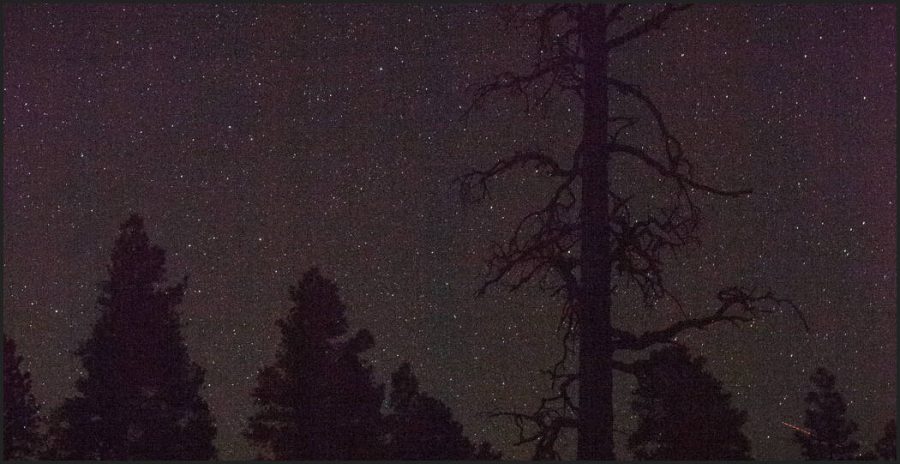
But to decide on a long digital exposure, you can’t just meter. So set the ISO to a high level. Say 52,000. While I would rarely settle on an ISO this high due to its ultra-high noise, it’s invaluable for seeing better in the dark.
With high-sensitivity exposure, you can check composition, light pollution, etc in moments. I can also get an idea if my focus and other settings look correct by zooming in on the preview. Doing this extra step will let you hack your shadows and control the light.
Let’s say I determined that at ISO 12,800 I would need a bit over 1 minute to capture the stars silhouetting the trees. At that point, I doubled that minute for each full ISO stop (doubles and halves from Shadow Hackers). Say I want at least a 30-minute exposure. I’m going down now on ISO based on this test shot.
ISO 6400 = 2 minutes, 3200 = 4 minutes, 1600 = 8 minutes, 800, 16 minutes, ISO 400, 32 minutes etc. I can use this test frame not only to review my setup but to see how much light I will capture (only with less noise in my final) and then adjust the aperture etc, accordingly.
In a talk of how to photograph stars, this is a powerful tool. I rarely use an ND filter. Those are for daytime long exposure or cities. For dark landscape night scenes I will use ISO and aperture in these ways to decide how to expose.
Test shot I did of my setup at ISO 25,600 to see if everything was working.
How to photograph stars and get it natural.
A lot of folks in the digital world use a trendy stacking technique. They take a lot shorter exposures of the night sky and then blend them in post using stacking software. This can produce beautiful results, and there is nothing wrong with that method.
But in a new AI world where everything feels fake and people are tired of fake. Stacked stars in no way produce the same look, and I prefer the in-camera approach of long methodical exposures like we did with film.
Not all star trail photography has to be this long. But I wanted something special tonight.
I started the exposure, locking it into the bulb using my cable release. Then I returned to the camper, and my alarm went off 2 hours and 15 minutes later. I went out, being very careful not to shine a flashlight near the scene or lens which would ruin my image in an instant.
Also, photograph stars in shorter long-exposures.
Not all night scenes need to be stars and not all star trails need to be this long.
What I’m telling you applies to many long exposure scenes. But when I do stars I want them as part of a landscape. It’s not a Hubble photo.
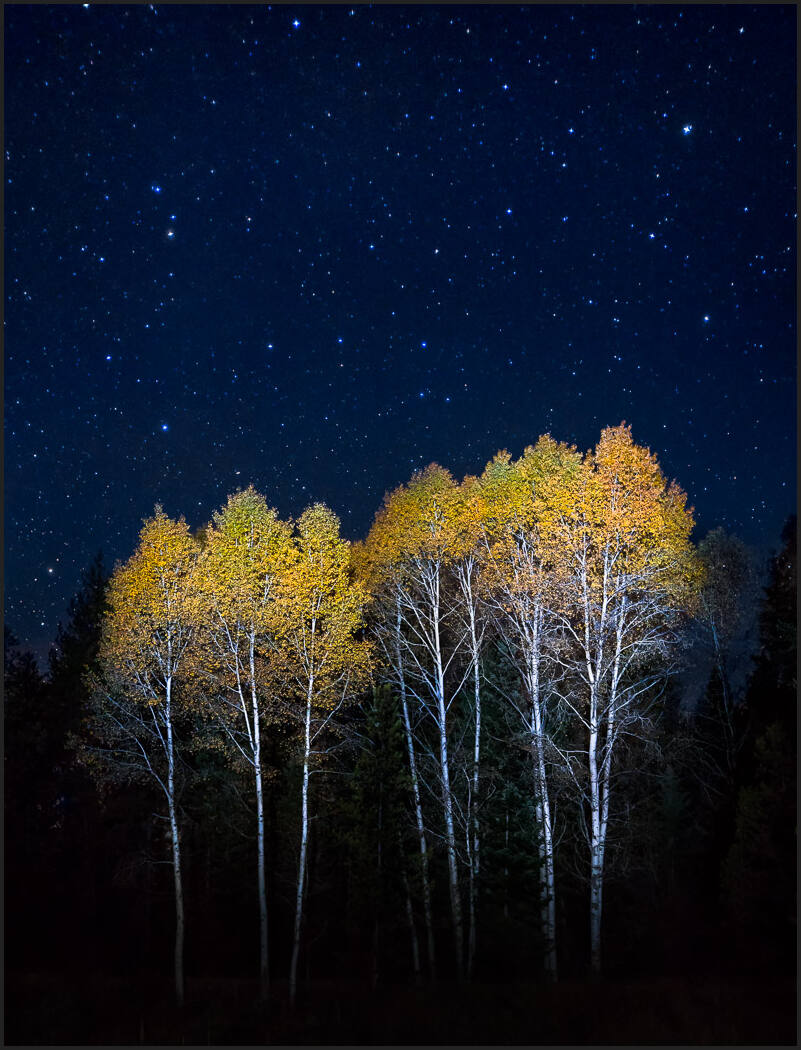
With newer cameras, we can do higher ISO deep field photos. Like my light-painted photo – Night in the Aspens of North Washington State. It took only 13 seconds to about the stars from blurring.
DEEP field star landscapes. Star trail landscapes
These are the two main categories in this. The 3rd is stacking star photos which we don’t cover here today. Whether to go long or short (in your long exposure) is up to you, your time, your gear, etc. Both styles are stunning.
If you want stars to be deep field points of light, you can’t go much past 15 seconds. Whereas if you want stars to be trails, you don’t want to go much below 30 minutes because you will get small trail lines.
Star Trail photography is all about LONG. So low ISO. Deep field like this is a long exposure, but not too long. So to capture the deep field, use a camera that can handle higher ISO and get deep detail in a few dark seconds.
13 seconds at ISO 6400 on a Sony A7R MK2. Trees painted with an LED flashlight.
Tips to make a 140-minute star trail photo work
I had black frame noise reduction set to auto. Essentially, it takes an equal-length exposure with the lens blacked out to capture hot pixels on the sensor against black, allowing them to be mapped and removed.
On my 5D MK2, it didn’t seem to work and the camera did not do the auto dark frame. The camera did not count that high and maybe it lost track of how long the exposure was. It seems to stop counting at about 3o minutes, but the image did not stop 3exposing, just the metadata.
“A flashlight near the scene would ruin my photo in an instant.”
After the exposure, I went into the camper for review. It looked good, and the regular ISO noise was not bad at all, thanks to ISO 100. What I thought were hot pixels, however, were BAD and LR could not take those out. That said, it could have been worse. It was cool outside and the higher the outside temperature, the more the sensor heats up and produces this type of artifact.
I immediately decided to make a dark frame manually. This is a common approach done by setting the camera in the same conditions and taking an equal-length exposure with the lens cap on. It was late, so I set an alarm and set the camera outside starting the exposure, and went to bed, bringing it in and stopping the exposure when the alarm expired. Another 140-minute black exposure in the same conditions as my reference for later.
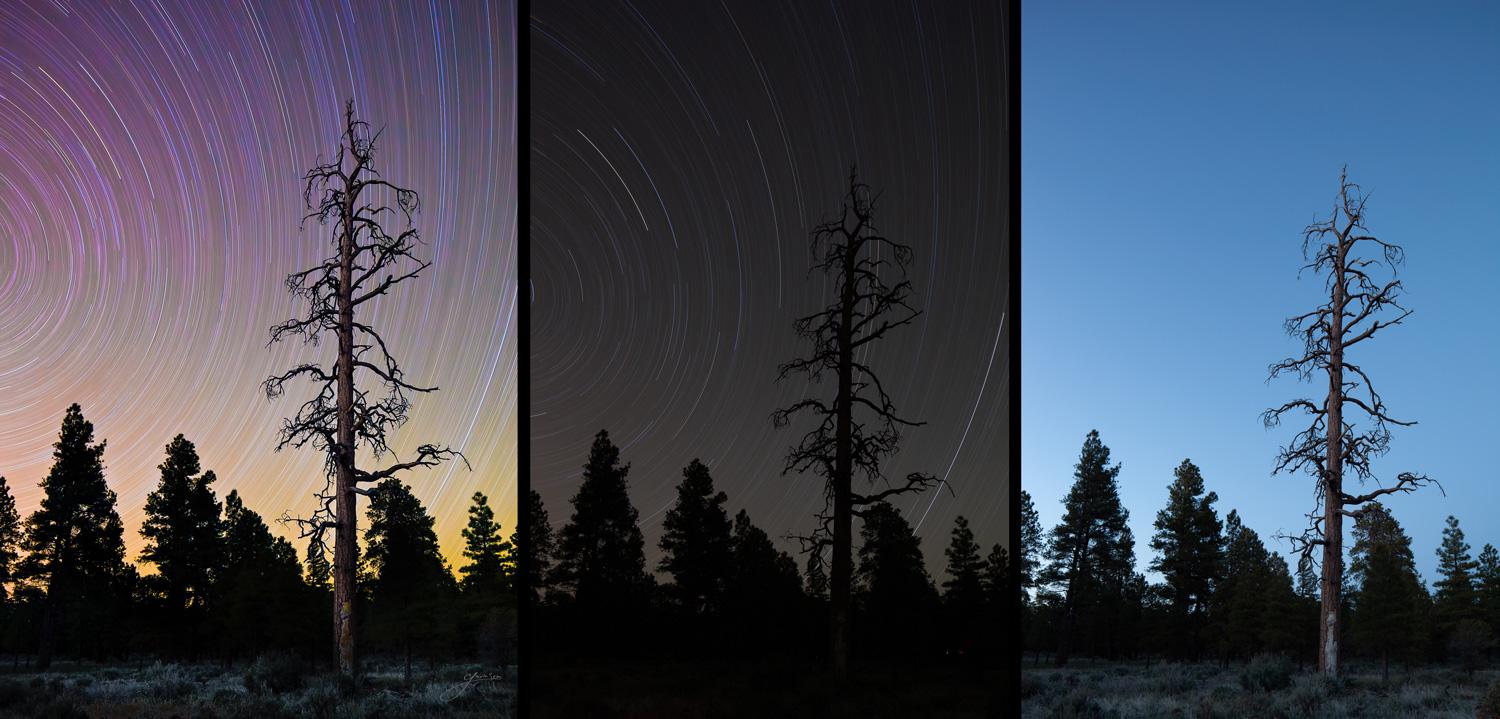
The twilight image for detail along with the RAW of the 140-minute exposure next to the final process.
After a base edit I went into the sliders, working the color, noise, and detail carefully to get everything as good as I could before going to Photoshop.
Understand that most night images that the night is dark. Cameras like film are made to see best in the light. As often happens with night images and RAW files the light and color were flat. I had to boost the highlight a lot to bring out the separation of stars. Ditto for other settings.
This is something you have to expect. The sky is deep with stars and even the one you can’t see backlight that sky. That means to make the stars stand out that separation has to be defined and this is especially true with digital raw files since they shoot flat giving us lots of information to work with.
Don’t shoot the night in JPEG. You may get a bit more content but it will fall apart with the amount of boosting you typically need to do. After RAW processing, I went into PS with the main image and added the twilight image. I very gently masked the area around the trees, bringing in detail to prevent the foreground from being black, but not so much as to become a distraction. The silhouetted tree is still my subject.
10 Seconds at ISO 12,800 – I could not have captured a shorter long exposure deep field scene like this with the 5D MK2. But new sensors can let you see amazing things if you set them up well.
Long star trail night exposures and noise problems.
These are two exposures. The secondary is just my pre-night reference frame for detail and manually blended. I took a frame of the final composition just as the sunset. But that frame retained detail in the foreground so I painted a little of it in since it lined up perfectly. I did not try and blend HDR or anything like that. It was just used to restore texture to really dark areas.
Noise or rather heat artifacts on this era camera were a big problem. Long exposure like this won’t damage your camera, but it can result in artifacts. NOTE that I’ve noticed this problem far less on newer mirrorless cameras. I think it’s because they have to manage heat better. After all, they are also designed for video. But even on newer cameras, the following tips may help.
I set to work trying to get rid of those pesky artifacts that you can see in the example below. I started with basic black frame reduction. Bringing my dark frame of equal exposure into PS, I laid it over the image, then set its blending mode to difference. The goal here is to take the spots of the image and effectively subtract them from the ones mapped on the black frame. I tweaked the opacity to avoid them appearing as darker dots, and that was the process.
It worked. But not enough. I continued to use variations of the black frame with different settings, using the same approach but hoping to target pixels differently. It’s normal to use multiple layers when doing this manually, and, again, this helped, but I was not home-free; I wanted a large wall print of this. I may have been better off making two or three dark frames to get slightly differing, hot pixel patterns, though that would have taken most of the night.
After this, I then used Topaz De-Noise on a copied layer of the main image. Even though this is not normal noise, it did help out. But to avoid killing the detail from aggressive noise reductions I could not apply the Topaz too heavily. I was getting closer, but there were still dots.
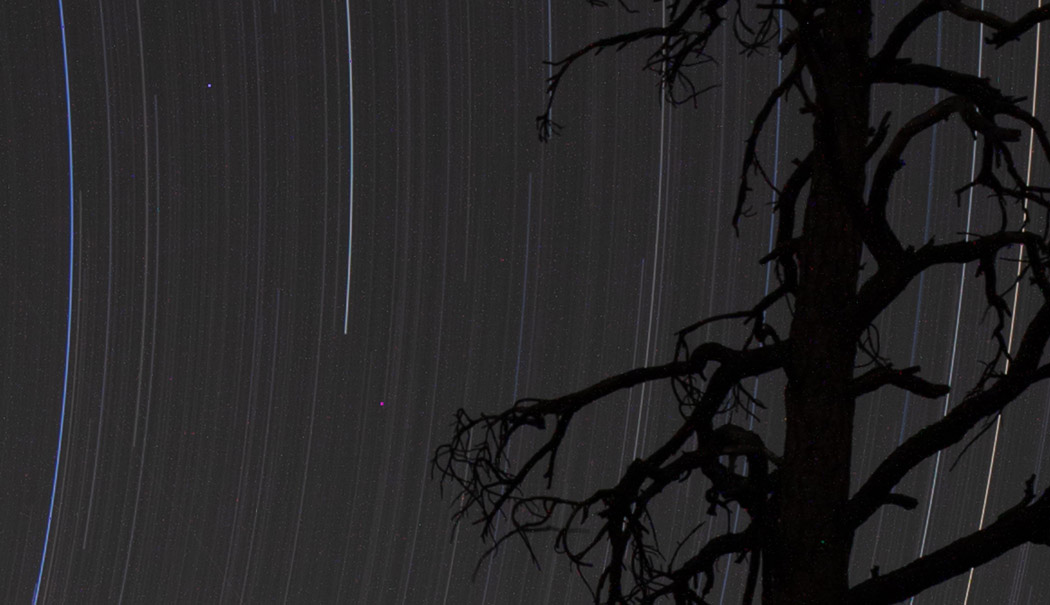
See the dots. The stars are trails, those are not part of the sky but sensor artifacts. Since no one I knew even did exposure this long I had no data on how to handle them back in 2011.
Fixing heat spots and artifacts from long star exposures.
This part is nerdy and in the AI noise reduction world with the better sensors we have today, you will probably have to do as much as I did even for a 2-hour-long exposure. But keep these techniques in mind.
After hours of working with this image, researching alternate ideas, and trying in various ways to destroy the dots, I was closer but not as close as I wanted. I won’t go into all my tests, but using everything I described above, I finally added a merged copy of the main image layer group with all the previous corrections combined into it. I then used the de-speckle tool in PS, and this helped a lot but left the image with a huge loss of detail.
So I made a copy of the layer and boosted up its contrast with curves and levels to the point at which it was way overdone and had ultra-hard edges. Then hit select all on the contrasting layer, copy that layer, and turn it off.
I added a mask to the de-speckled layer, and, instead of mask painting with a brush, I Opt (Alt) clicked the mask icon to bring it into mask view mode. Then I posted the actual contrasted image over it as a mask (cmd + v), which made a grayscale mask that matched the contrasted image. This masked away hard edges and detail on the de-specked image, revealing the more detailed layers below.
Star trails that printed perfectly.
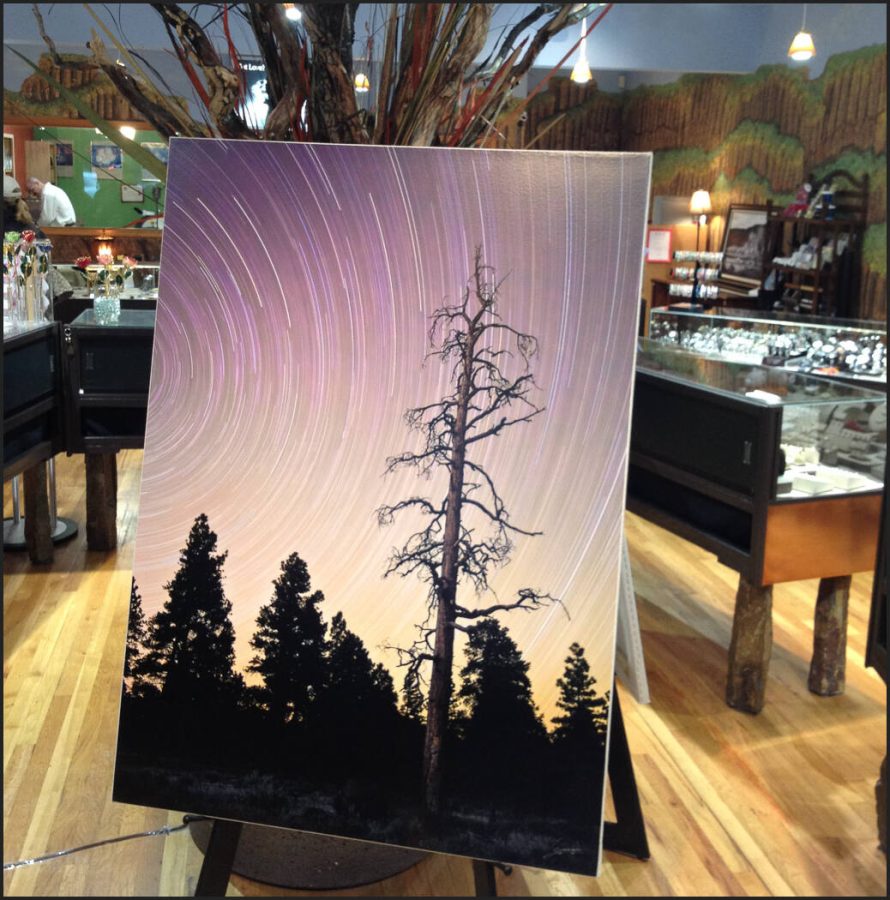
Doing star trail photography right is hard and slow. But the work paid off and I had the detail, the sharpness, and the quality. My master print was this 50-inch on bonded canvas.
Cameras have come a long way since this exposure was made, but sensors still face similar problems at times. Taking the time to set up, plan, review, and process this carefully gave me an image I can be proud of and one that looks great on the wall.
These are my thoughts on how to photograph the night and what I did here. Keep experimenting and leave your comments with your own tips.





 by
by